KAWS: The Subversion that Took Over the Art World
KAWS: The Subversion that Took Over the Art World
From illegal graffiti on NYC phone booths to the high-stakes auction rooms of Sotheby’s, the trajectory of Brian Donnelly—known globally as KAWS—is a masterclass in how street culture and fine art can collide to redefine the mainstream.
The Roots: From New Jersey to the Rooftops
Born in 1974 in Jersey City, Brian started like many others: sketching letters in notebooks and on walls. The tag "KAWS" wasn't chosen for a deep philosophical meaning; he simply liked the way the four letters looked together—balanced and visually striking. As a teenager, he famously painted the tag on a building roof near his high school just so he could see it from the window during class.
However, the real shift happened when he moved to New York City to study at the School of Visual Arts (SVA). Armed with a skeleton key gifted by fellow artist Barry McGee, KAWS began his era of "subvertising." He would unlock bus shelter and phone booth ad panels, take the posters home, paint his signature characters over the models and products, and return them to the street. This "forced collaboration" with corporate imagery defined his visual language and caught the immediate attention of the art world.
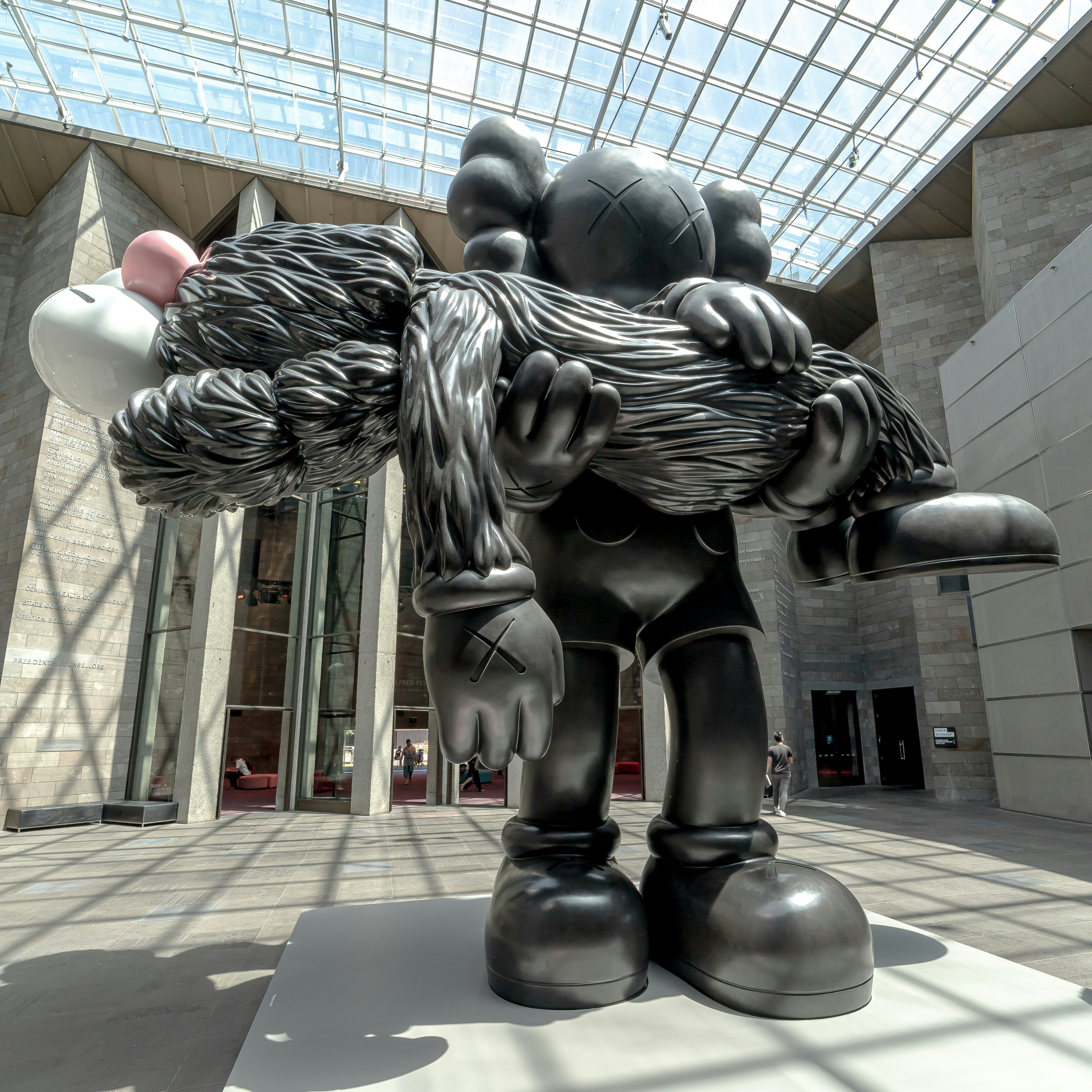
GONE (2019), by James Mason
The Precision: Disney and the Hip-Hop Connection
KAWS’ technical mastery was no accident. After graduating in 1996, he worked as a freelance animator for Disney, painting backgrounds for shows like 101 Dalmatians, Daria, and Doug. This professional training gave him the tools to subvert pop icons with a level of industrial perfection that set him apart from other street artists.
Since then, his ascent has been fueled by a series of legendary collaborations:
Music: Creating iconic visuals for Kanye West (808s & Heartbreak), Pharrell Williams, and Travis Scott.
Fashion: Bridging the gap between accessible design with Uniqlo and high-fashion luxury with Dior and Nike.
Design: Launching OriginalFake in Japan, which turned "art toys" into high-value collectibles.
The Icon: The Rise of the Companion
If there is one figure that defines the KAWS legacy, it is the Companion. Created in 1999, the character—a dystopian take on Mickey Mouse with "X" eyes and skull-and-crossbones features—became the center of his universe.
What began as an 8-inch vinyl toy evolved into monumental bronze sculptures and massive inflatables floating in harbors from Hong Kong to Seoul. The Companion is more than just a character; it carries an emotional weight of isolation and vulnerability that resonates globally across cultures.
2026 Status: Museums and Multi-Million Dollar Sales
Today, KAWS occupies a space few artists ever reach. He is as relevant in Fortnite (where his Serpentine Gallery show was recreated in 1:1 scale) as he is in the world's most prestigious institutions, such as the Brooklyn Museum or his current major exhibition at the SFMOMA (running through May 2026).
His impact is measured by both digital reach and market value. In 2019, his work The KAWS Album sold for a record-breaking $14.8 million. Often compared to Andy Warhol and Keith Haring, Brian Donnelly has proven that the "low" art of the streets and the "high" art of the museum are, in fact, one and the same.
From illegal graffiti on NYC phone booths to the high-stakes auction rooms of Sotheby’s, the trajectory of Brian Donnelly—known globally as KAWS—is a masterclass in how street culture and fine art can collide to redefine the mainstream.
The Roots: From New Jersey to the Rooftops
Born in 1974 in Jersey City, Brian started like many others: sketching letters in notebooks and on walls. The tag "KAWS" wasn't chosen for a deep philosophical meaning; he simply liked the way the four letters looked together—balanced and visually striking. As a teenager, he famously painted the tag on a building roof near his high school just so he could see it from the window during class.
However, the real shift happened when he moved to New York City to study at the School of Visual Arts (SVA). Armed with a skeleton key gifted by fellow artist Barry McGee, KAWS began his era of "subvertising." He would unlock bus shelter and phone booth ad panels, take the posters home, paint his signature characters over the models and products, and return them to the street. This "forced collaboration" with corporate imagery defined his visual language and caught the immediate attention of the art world.
GONE (2019), by James Mason
The Precision: Disney and the Hip-Hop Connection
KAWS’ technical mastery was no accident. After graduating in 1996, he worked as a freelance animator for Disney, painting backgrounds for shows like 101 Dalmatians, Daria, and Doug. This professional training gave him the tools to subvert pop icons with a level of industrial perfection that set him apart from other street artists.
Since then, his ascent has been fueled by a series of legendary collaborations:
Music: Creating iconic visuals for Kanye West (808s & Heartbreak), Pharrell Williams, and Travis Scott.
Fashion: Bridging the gap between accessible design with Uniqlo and high-fashion luxury with Dior and Nike.
Design: Launching OriginalFake in Japan, which turned "art toys" into high-value collectibles.
The Icon: The Rise of the Companion
If there is one figure that defines the KAWS legacy, it is the Companion. Created in 1999, the character—a dystopian take on Mickey Mouse with "X" eyes and skull-and-crossbones features—became the center of his universe.
What began as an 8-inch vinyl toy evolved into monumental bronze sculptures and massive inflatables floating in harbors from Hong Kong to Seoul. The Companion is more than just a character; it carries an emotional weight of isolation and vulnerability that resonates globally across cultures.
2026 Status: Museums and Multi-Million Dollar Sales
Today, KAWS occupies a space few artists ever reach. He is as relevant in Fortnite (where his Serpentine Gallery show was recreated in 1:1 scale) as he is in the world's most prestigious institutions, such as the Brooklyn Museum or his current major exhibition at the SFMOMA (running through May 2026).
His impact is measured by both digital reach and market value. In 2019, his work The KAWS Album sold for a record-breaking $14.8 million. Often compared to Andy Warhol and Keith Haring, Brian Donnelly has proven that the "low" art of the streets and the "high" art of the museum are, in fact, one and the same.
SHARE
Latest articles